On Fatigue (or We Tired/The Struggle Continues)

NPR

On Bisan

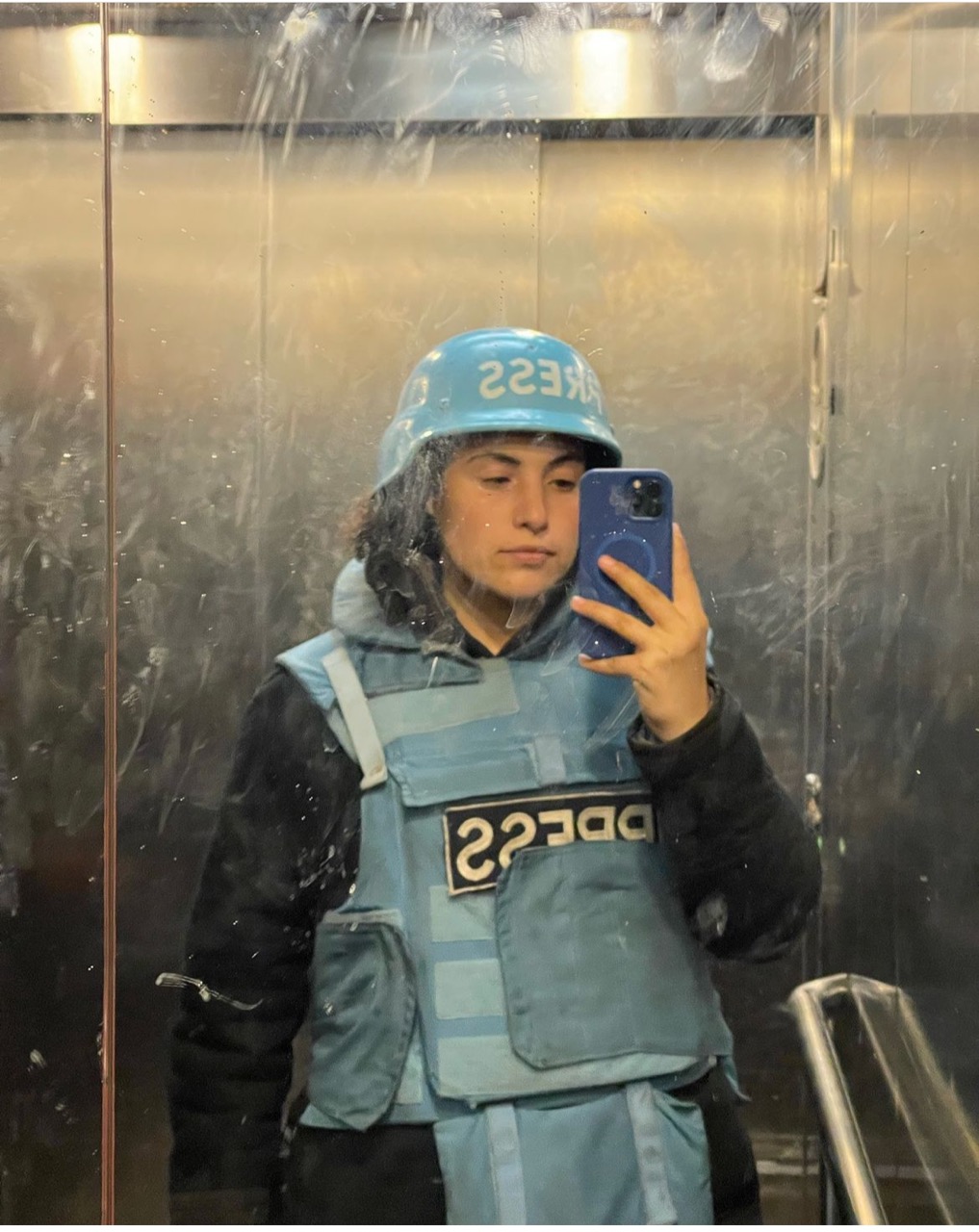
There were twelve thousand viewers glued to the livestream as I clicked into Bisan’s video. Wrapped in a baby blue PRESS vest and matching helmet, she huddled in a dark room at Nasser Hospital with 3 to 4 other Gazans speaking rapid-fire Arabic as drones buzzed in the background. Her tired dark eyes were grim and threaded with terror as she read the flood of comments across her screen. She plead with followers to educate themselves on Zionist aggression against Palestine and to demand a ceasefire. Automatic gunfire rang out as people placed virtual flower crowns and chintzy cowboy hats on her head. This genocide is being live-streamed. 

As I sat in my humid bathroom glued to the screen I had to remind myself to blink. To breathe. To pray. When would the moment come when a bomb struck her building or an IOF solider fired through the door? Would her connection drop upon impact or would we see her flesh blown apart in real time? Every 30 seconds or so, Bisan would wince or silently gasp as the artillery noise inched ever closer. As if to confirm she wasn’t trapped in a dream, she’d ask the viewers if they heard it too. Viewing the livestream was like floating in a sea of thousands of death doulas holding her virtual hands. We came to bear witness. If this be the bitter end, damnit she won’t be alone. 

The buzzing of the armed drones crawled deeper and deeper into my brain. I struggled to tamp down panic. The sort of panic that comes when you are body slammed by the sudden realization that you are utterly helpless in this moment. Chants for a ceasefire and protests in the street and social media shares cannot remove Bisan from the dark warrens of a hospital under bombardment. I can only watch…and wait.

25 thousand* Gazans have been killed since Israel began its campaign in Palestine. Thousands more have been wounded/orphaned/starved to death. To say nothing of the untold number of bodies buried under the rubble. The numbers are staggering. The sheer volume of killing lends itself to abstraction. Statistics about the deaths per hour and exponentially larger casualty counts mask the very human lives so cruelly being snuffed out. And so I clutch at Instagram Stories and TikToks and X feeds about the reality on the ground. I zoom in on photos. I learn their names. Motaz has hung up his journalist hat to turn inward and embrace his family as bombs continue to fall. Plestia, although she’s made it to Australia, continues to use her platform to foreground images of Palestinian joy amidst scenes of devastation. Al-Jazeera journalist Wael buried his son Hamza before dashing back to the ruined and bloody halls of a local hospital to report on the unfolding catastrophe on babies and other civilians. He was recently evacuated to Egypt (then Qatar) after narrowly surviving an IOF drone assault. 

Following the initial assault on Nasser Hospital the Israelis dropped Gaza into yet another communications blackout. I’d refresh my Instagram every hour praying for an update from Bisan. As I moved through the next 24 hours, time seemed to thicken and slow down. I struggled through what felt like an absurd work routine. Virtual meetings, Outlook notifications and production metrics provided a soundtrack to my dreadful anticipation of her death. And then there it was. An Instagram story from Bisan calling for a Global Strike from January 21st to January 23rd. She admonished us (me) to not despair, to keep up the fight against this second Nakba. Same baby blue PRESS vest, same matching helmet. Standing in front of a dirty mirror, Bisan spits in death’s face and affirms that after 107* days of genocide she’s still alive. 

Free Palestine. 

*The casualty count increases daily.

*109 days at the time of this writing. The assault on Gaza continues.

Dying of Thirst in Flint: On the State-Sponsored Poisoning of an American Community

la-na-flint-water-20160122
Jake May/ The Flint Journal


Fecal chloroform, rust, sediment, and lead flowed from thousands of taps for months before local government issued a boil order. Patients complained of rashes and hair loss. Children with signs of lead poisoning crowded clinics while Legionnaire’s disease reared its ugly head. Dramatic reports of water with a funny smell, a sick yellow hue, and a foul taste hummed in the background of this dying industrial city. Physicians such as Dr. Mona Hanna-Attisha sounded the alarm about lead poisoning ruining the potential of Flint’s children, while the Snyder administration studiously denied the grim reality on the ground. While this disaster unfolded, Flint’s residents, largely poor and black, languished under the supervision of a parade of emergency managers solely focused on the bottom line. Access to clean water is a fundamental human right. $5 million was the price to revoke that right in Flint, Michigan.

Flint is a city choking on the decay of post-globalization capital flight. The closure of several GM plants in the 1980s devastated the “Vehicle City”. The resultant disappearance of stable, middle-class manufacturing jobs precipitated a cycle of population flight and deindustrialization that continues to haunt the area today. With a population nearly 60% African-American, and a 42% poverty rate, the city was ripe for governmental schemes aimed at stripping away basic services in order to keep a fingernail’s hold on solvency. Enter the era of emergency management.

The saga of Flint’s water crisis is rooted in the destruction of local democracy in favor of an anti-democratic, top-down approach in which citizens aren’t afforded the right to influence public policy. In 2012, the Michigan state legislature passed Public Act 436, a law designed to rescue financially distressed municipalities from themselves. What the law achieved in fact was the creation of the legal and political space for an unelected official, referred to as an emergency manager, to dictate public policy with zero democratic accountability. The language of PA 436 is quite explicit in neutering the power of local elected officials. Section 141.1549 reads:

Following appointment of an emergency manager and during the pendency of receivership, the governing body and the chief administrative officer of the local government shall not exercise any of the powers of those offices except as may be specifically authorized in writing by the emergency manager…

This passage effectively smothered the democratic institutions of Michigan’s most troubled cities by disenfranchising their most vulnerable population, poor blacks. The denizens of Flint, Detroit, and several other poor municipalities with majority-minority demographics have shouldered the devastating effects of this state-sponsored dislocation from democracy.

In the face of lawsuits and heated criticism of PA 436, officials in Lansing called into question local representatives’ capacity to negotiate the terrain of their most pressing public policy challenges. In an almost dismissive defense of local concern, Terry Stanton, of the Michigan Department of the Treasury, was quoted, “making difficult political decisions can be very trying for local officials.” Stanton’s response betrays a noxiously paternalistic view of local elected officials. Wrestling with tough political decisions is  the mandate for city representatives. Should the aftermath of their decisions prove unproductive, residents can petition the institution, hold a referendum, or simply vote officials out of office. Unfortunately, by focusing on the deficiencies of local governing bodies, Lansing failed to take advantage of the opportunity to attack the structural issues that hinder Michigan’s progress.

In 2013, Snyder-appointed emergency manager Ed Kurtz, in cooperation with the Flint city council, backed a vote to sever ties with the Detroit Water and Sewerage Department as a cost-cutting measure. It was decided that the Flint River—a notorious dumping ground—would hydrate city residents until the completion of the Karegnondi water pipeline in 2016. Kurtz’s successor, Darnell Earley, rebuffed offers to extend Flint’s contract with DWSD, instead preferring to collaborate with the Michigan Department of Environmental Quality to obtain the permits needed to switch the city’s water supply to the local river. April 25th, 2014 marked the beginning of Flint’s dance with environmental racism.

Nearly two years later, the national media has turned their spotlight on Flint. Although local media such as the Detroit Free Press and Michigan Radio reported on the crisis from the outset, national outlets focused their human rights reportage on Syria and the various refugee crises gripping Europe. The pace of national coverage of the poisoning of Flint has moved from a localized trickle to a flood of bleeding-heart outrage on the editorial pages of the big players. The unfolding scandal is a study in how the paucity of political influence opens the door to stunningly racist public policy. The majority-black demographics of Flint (and other black cities in Michigan under emergency management) are an inescapable fact that must remain in the forefront of any serious analysis of this tragedy. It’s incredibly difficult to insist that the white residents of say, Grand Blanc, would be stonewalled in the face of pointed questions about local water quality.

After months of what the Flint Water Advisory Task Force characterized as state agencies’ “…aggressive dismissal, belittlement, and attempts to discredit these efforts [to expose lead contamination] and the individuals involved,” Governor Snyder finally requested a federal declaration of emergency last month. President Obama quickly signed the declaration, which will free up $5 million in federal aid for the next 3 months. In a bid to influence the optics, Snyder also activated the Michigan National Guard to distribute bottled water and filters to desperate residents. He gave a speech apologizing to Flint residents, and then released 274 pages of emails related to the disaster. Snyder’s emails provide a window into the state’s stubborn refusal to acknowledge that the Flint River is toxic. In fact, concerned residents and groups were accused of using reports of lead poisoning as a “political football”. One email from a local pastor even warned of the potential for civil unrest.

Governor Snyder has released an estimate of $60 million to replace all of the lead piping in Flint. If the project is fully funded, total replacement would take at least 15 years. The logistics and financing of such a massive undertaking have yet to be ironed out. As of today, Flint has to get by with bold declarations of support that are paper thin. The House Committee on Government Oversight and Reform has heard testimony from Flint officials and one resident on the disaster in their city. Governor Rick Snyder and Darnell Earley were notably absent from the hearing. Snyder was not invited to attend, and disgraced former emergency manager Earley defied a congressional subpoena.

There was the trademark outrage from ranking Democrat Elijah Cummings (Md.), who quoted song lyrics and implored the witnesses to reflect on the devastating impact on Flint’s children. Meanwhile, partisan fissures emerged over two issues—first, House Republicans did not invite Snyder to testify at the hearing (nor did he volunteer to show), and second, Senate Democrats blocked an energy bill because it doesn’t earmark funds for disaster relief in Flint.


-61dcac5b609c6bbe
Courtesy of Mlive.com

Although Flint switched back to the Detroit water system in October, the decaying infrastructure of rusted out piping continues to present a health hazard. Lead continues to leach into the water from local pipes. Recent testing by researchers with Virginia Tech found lead levels that meet the threshold for hazardous waste. In another blow to relief efforts, the EPA has notified the city that the consumer-grade Brita and Pur water filters being distributed are not up to the task of blunting the flow of lead that in some areas exceeds 150 parts per billion. Thus, residents will need to continue to rely on bottled water for cooking and bathing. Because Flint is a food desert, residents are particularly dependent on sustained governmental action to provide clean water. They can’t simply roll into the nearest Wal-Mart to stock up on water. There are quite literally, no other options.

Governor Snyder needs to resign effective immediately. The Michigan State Legislature should immediately repeal that odious law, PA 436. Finally, Senate Republicans should open the purse and fund extended disaster relief for Flint. Anything less is yet another tragedy.


Hillary Clinton vs. Black Lives Matter

Just watched this two-part video of a backstage meeting between 2016 Democratic Candidate Hillary Clinton, and several activists from the #BlackLivesMatter Movement.

I actually garnered a lot more respect for Clinton after seeing this exchange. Her focus on relentlessly tackling policy changes was spot on. Obviously, her family’s complicity in promoting race-based mass incarceration is noxious, and her current bid for the presidency is troubling.

I respect the #BlackLivesMatter movement and believe that their existence is critical to spurring the sort of “national conversations” that the corporate media always insists we need. However, we can recite stats about prison populations, the vestiges of slavery, a lack of adequate education and housing, institutionalized racism, micro-aggressions, and anti-black police violence all day long (and those conversations will never stop). The movement is hyper-intellectual, which is critical to its current success and national legitimacy. We know our shit. It’s not simply a swarm of black people running around incoherently yelling about “the man”.

But, what I’m ready to see is a platform. A draft bill. A candidate. A policy roundtable. A white paper. Something more tangible that catalyzes forward movement on the legislative side.

We have the intellectual butter. We need the policy guns.

Will Someone Please Think of the White Women?! Or, why Patricia Arquette is a tone-deaf bitch.

Arquette Oscars Speech
Patricia Arquette accepts the award for Best Supporting Actress
Photo by Kevin Winter/Getty

During her acceptance speech at the Oscars last Sunday, actress Patricia Arquette made an attempt to rally white feminists by calling for equal pay. On the surface, Arquette’s standard issue rallying cry was the sort of policy-lite that could be hashtagged and memed for days. However, things went south backstage when she was asked to elaborate her onstage comments. In a breathtakingly ignorant move, Arquette asserted that white women had done their part in agitating for the civil rights of “everybody else” (read: blacks and gays)—and now it’s their turn. Her response betrayed a fundamental flaw in mainstream, American feminism—the repeated failure to acknowledge the socioeconomic ramifications of intersectionality. In other words, the movement’s failure to recognize that one can be both a feminist and a poc and even, by god, LGBT. She offered the following wisdom behind the curtain:

“And it’s time for all the women in America and all the men that love women, and all the gay people, and all the people of color that we’ve all fought for to fight for us now”.


In her self-righteous bid to briefly don the “activist cape”, Arquette denied the ongoing struggle of people of color and LGBT citizens. Her reflexive universalization of the experiences of leisure-class white women revealed an unsophisticated understanding of the fight for equality. The actress’s failure to recognize the interplay of race, class, and gender mirrors broader issues within feminist movement.

Black feminists in the academy long ago recognized the immutable reality of intersectional identities. Pioneering work by Kimberle Crenshaw (who coined the term intersectionality) and bell hooks, among many others, attacks the notion that one has to be either a feminist or a woc. Most feminists of color recognize that systems of oppression do not operate in isolation, and thus reject the dictate that the struggle for minority rights is a separate and competing agenda.

Unfortunately, the popular imagination still clings to the framework first put forth by Betty Friedan. This is a framework centered on middle-class, college educated white women. Today, the daughters of Friedan’s peers want to lean in and be compensated appropriately for it. Essentially, these women want to compete on the battlefield of capitalism and achieve financial parity with their white, male counterparts.

Arquette’s appeal conveniently ignored the fact that black women and Latinas routinely earn less, dollar for dollar, than their white peers. An analysis of Census data conducted by the American Association of University Women (AAUW) found that while white women earn 78% of the earnings of their white male counterparts, black women only earn 64%, and Hispanic women make even less at 53%. A quick look at the numbers muddles Arquette’s simplistic argument for fair pay.

The data collected by AAUW shows that race has an almost decisive impact on the lifetime earnings of women of color when compared to those of white women. Furthermore, deeper analysis of the numbers demonstrates that higher education amongst women of color does little to mitigate the persistence of the pay gap. Arquette’s use of a heteronormative, white, male-vs-female dualist framework to attack gender-based pay discrepancies erases the unique challenges faced by women with intersecting identities.

Ultimately, rather than taking a moment to seriously question an economic system that is highly stratified and marked by crippling inequality, the actress instead chose to unconsciously endorse a mode of production that must necessarily keep a significant percentage of the population on the bottom rungs. Instead of insisting on parity in a grossly unfair system, Arquette would have been better served to call for the structural changes that would make such concerns largely null and void. Perhaps next time Patty, you can struggle for women across the race-class-sexuality spectrum.

Actually…don’t bother. Intersectional feminists can agitate just fine for our damn selves.